

The Sports Parent’s Playbook: Supporting Your Student Athlete Without Burning Them Out
October 29, 2026
The Complete Player: Skill Wins Games, Character Wins Everything Else
October 31, 2026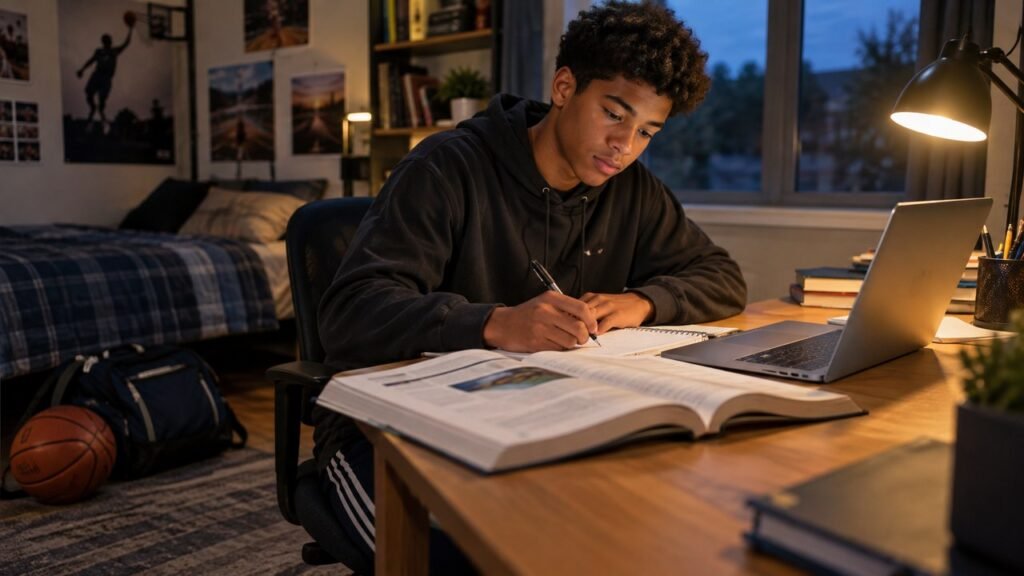
By The Redeemer Sports
There is a reason the word “student” comes first in “student athlete.” Your eligibility, your recruiting options, and honestly your brain’s ability to learn plays all depend on what happens off the field. The good news: the habits that raise your grades are the same habits that raise your game. Here is how to get better at both, backed by the NCAA, the CDC, the NIH, and the American Psychological Association (APA).
Key takeaways
- Know the eligibility math: NCAA Division I requires 16 approved core courses, a minimum 2.3 core-course GPA, and 10 core courses (7 in English, math, or science) finished before your seventh semester.
- Test yourself, don’t just re-read: students who practiced spaced self-testing remembered 80% of the material a week later, versus 30% for students who recalled it three times in a row or once (APA).
- Sleep is practice: ages 13-17 need 8-10 hours a night (CDC), and irregular bedtimes are linked to worse grades (NIH-funded study).
- Plan your week and ask early: counselors, teachers, and coaches can only help if you raise your hand before the problem is big.
Treat eligibility like part of training
If college sports are anywhere in your future, academic eligibility is not paperwork – it is part of your training plan. The NCAA Division I requirements are specific:
- Complete 16 NCAA-approved core courses, including 4 years of English, 3 years of math (Algebra I or higher), 2 years of social science, and 1 additional year of English, math, or science, plus additional core units.
- Meet the 10/7 requirement: 10 of those core courses – 7 of them in English, math, or science – must be completed before the start of your seventh semester (senior year).
- Earn at least a 2.3 core-course GPA. Only NCAA-approved core courses count in that number.
Not every class at your school counts as an NCAA core course. The NCAA’s own advice: review your school’s NCAA-approved course list and work with your counselor before finalizing your schedule, then create an account with the NCAA Eligibility Center. Do it early – catching a missing course in ninth grade is easy; catching it in twelfth grade is a crisis.
Study the way memory actually works
Re-reading notes and cramming feel productive, but psychologists say they are among the weakest ways to learn. The APA’s research-tested guidance points to strategies that make your brain work to retrieve information:
Quiz yourself, more than once, over several days
Retrieval practice – pulling information out of your memory – is the strongest technique researchers have tested. In one study, students learning word pairs who practiced repeated spaced retrieval remembered 80% of the material a week later, compared with 30% for students who recalled each item three times in a row or just once (Karpicke, via the APA). Same total study effort, dramatically different result.
In a separate study across nine college courses, students who took chapter quizzes multiple times with deadlines spaced throughout the course scored best on the exams. The takeaway for your season: short self-quizzes spread across the week beat one long Sunday cram – and they fit between practices.
Close the book
Even concept mapping only works when you do it from memory. Students who built concept maps with the textbook closed – recalling as much as they could – outperformed students who mapped with the book open. Flashcards work the same way: say or write the full answer before you flip the card, and keep retesting yourself in the days before the test.
Use the squad correctly
Study groups work when everyone has to think of answers independently, not when one strong student talks and everyone else nods. Answering aloud, or silently attempting each answer yourself before hearing it, is what makes the learning stick.
Sleep like it is part of practice – because it is
The CDC recommends 8 to 10 hours of sleep per night for ages 13 to 17 (and 9 to 12 hours for ages 6 to 12). Most teenagers are nowhere close: in the CDC’s 2021 Youth Risk Behavior Survey, the share of US high school students not getting enough sleep ranged from 71% in South Dakota to 84% in Pennsylvania.
The grade connection is direct. An NIH-funded study of nearly 800 adolescents found that those with more variable bedtimes had a greater chance of receiving a D or lower in their last grading period, while those who went to bed later, woke later, or varied their nightly sleep hours had fewer classes with an A. Your body is also when – not just how – you train: irregular sleep undercuts the recovery your sport demands and the learning your classes demand. A consistent bedtime is the cheapest performance enhancer there is.
Run your week like a season
Coaches plan a season; you can plan a week. Put your class schedule, practice times, and game days on one calendar, then assign study blocks to the open spaces – short ones count. Because spaced retrieval works better than massed study, three 25-minute blocks across a week will serve you better than one two-hour marathon the night before a test. Game day tomorrow? Front-load the work earlier in the week instead of relying on a late night that steals the sleep your performance needs.
Ask for help early
Every authority in this article points the same direction: talk to people before you are behind. Your school counselor can confirm which courses are NCAA-approved and track your core-course progress. Your teachers can tell you exactly what to fix while there is still time to fix it. Your coach has watched hundreds of athletes balance this load and almost always prefers an honest heads-up to a surprise eligibility problem. Asking early is not weakness – it is the move that separates athletes who stay eligible from those who scramble.
A note before you act: This article is for general education and is not medical, academic, or eligibility advice. Eligibility rules can change – confirm your situation with your school counselor and the NCAA Eligibility Center, and talk with a healthcare provider about sleep or health concerns.
Related reading from The Redeemer Sports: The Sports Parent’s Playbook: Supporting Your Student Athlete Without Burning Them Out and Healthy Children, Strong Habits: Movement, Sleep, and Food.
Frequently asked questions
What GPA does a student athlete need for NCAA Division I?
A minimum 2.3 core-course GPA, calculated only from NCAA-approved core courses. Division I also requires 16 core courses, with 10 core courses (7 in English, math, or science) completed before the seventh semester. Work with your counselor to confirm your courses are on your school’s NCAA-approved list.
What is the most effective way to study for exams?
Research cited by the APA favors retrieval practice – self-testing – repeated over spaced sessions. Students using repeated spaced retrieval remembered 80% of material a week later versus 30% for those who recalled it three times in a row or once. Re-reading and cramming are among the weakest methods.
How much sleep does a student athlete need?
The CDC recommends 8 to 10 hours per night for ages 13 to 17 and 9 to 12 hours for ages 6 to 12. In the 2021 Youth Risk Behavior Survey, most US high school students fell short – the share with insufficient sleep ranged from 71% to 84% depending on the state.
Does sleep really affect grades?
Yes. In an NIH-funded study of nearly 800 adolescents, variable bedtimes were linked to a greater chance of receiving a D or lower, and later bedtimes, later wake times, and variable sleep hours were linked to fewer classes with an A. The authors suggested that regular sleep schedules may improve academic performance.
Sources
- NCAA, Division I Initial Eligibility Requirements (16 core courses and distribution; 10/7 requirement; minimum 2.3 core-course GPA; counselor and Eligibility Center guidance): https://www.ncaa.org/eligibility-center/initial-eligibility-requirements/division-i/
- American Psychological Association, Six research-tested ways to study better (retrieval practice and spacing; 80% vs 30% recall study; spaced quizzes across nine courses; closed-book concept mapping; study groups; interleaving): https://www.apa.org/ed/precollege/psychology-teacher-network/introductory-psychology/study-better
- CDC, About Sleep (8-10 hours recommended for ages 13-17; 9-12 hours for ages 6-12): https://www.cdc.gov/sleep/about/index.html
- CDC, FastStats: Sleep in High School Students (2021 Youth Risk Behavior Survey; insufficient sleep ranging from 71% in South Dakota to 84% in Pennsylvania): https://cdc.gov/sleep/data-research/facts-stats/high-school-students-sleep-facts-and-stats.html
- NIH, Irregular sleep and late bedtimes associated with worse grades for high school students (study of nearly 800 adolescents; variable bedtimes and D-or-lower grades; fewer A’s): https://www.nih.gov/news-events/news-releases/irregular-sleep-late-bedtimes-associated-worse-grades-high-school-students
Source pages retrieved October 30, 2026.

1 Comment
[…] The complete player treats education as part of the game plan: eligibility, graduation, and real options after school all live in the classroom. We covered the practical side – NCAA eligibility requirements, research-tested study methods, and sleep – in The Student Athlete’s Edge: How to Raise Your Grades and Your Game at the Same Time. […]