

The Student Athlete’s Edge: How to Raise Your Grades and Your Game at the Same Time
October 30, 2026
Playing for More Than a Trophy: Stephen Curry’s Faith on the Court
November 1, 2026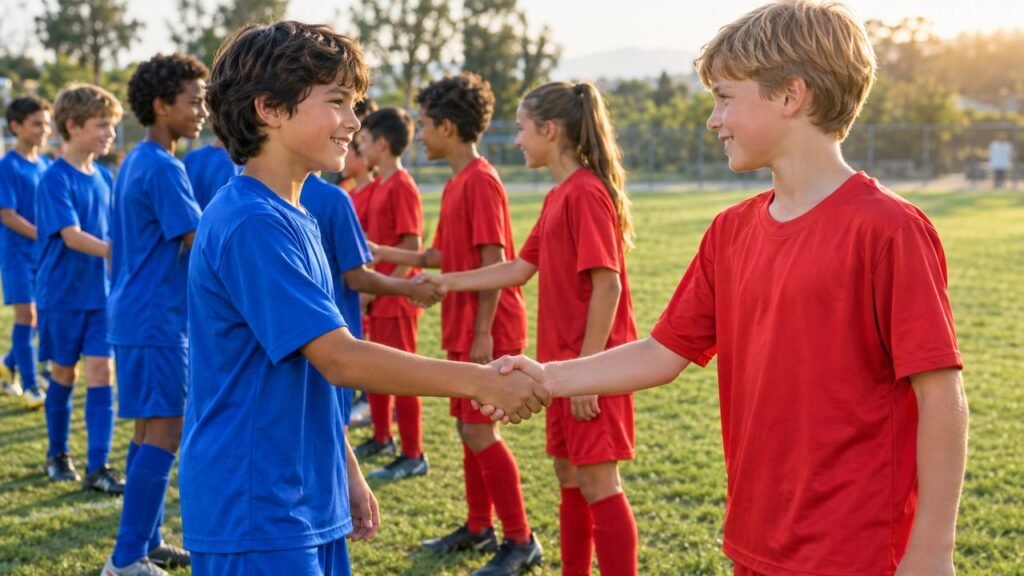
By The Redeemer Sports
Every team has talented players. Far fewer have complete players – the ones who bring skill, character, and a learner’s mind to the field at the same time. Talent might get you noticed for a season. Character is what coaches remember, what teammates trust, and what carries into every classroom, job, and relationship after the final whistle. Here is what the National Federation of State High School Associations (NFHS), TrueSport (the U.S. Anti-Doping Agency’s youth outreach program), and the Aspen Institute’s Project Play say about becoming that kind of player.
Key takeaways
- The NFHS standard: “Good sports win with humility, lose with grace and do both with dignity.”
- Character is trainable: students reported more life-skill and character development when coaches led with compassion (TrueSport).
- Redefine winning: skills mastery is more fun for athletes and keeps them in sport longer than a must-win mentality.
- School counts: high school students say schoolwork is the number one reason they do not play sports – the complete player treats class as part of the game, not a competitor to it.
Sportsmanship is the scoreboard that follows you
In the NFHS’s 103-year history, good sportsmanship has been one of the most important outcomes of high school sports – and the organization made it the No. 1 Point of Emphasis across all sports for the 2022-23 season after a rise in unsporting behavior. NFHS playing rules are written to encourage sportsmanship, and participation is meant to promote respect, integrity, and sportsmanship in everyone involved.
The NFHS sums up the standard in one sentence worth memorizing: “Good sports win with humility, lose with grace and do both with dignity.” High school sports, the organization writes, exist to lift people up, not to demean or tear people down – and that includes opponents and officials, not just your own teammates.
This is not abstract. The NFHS directly links the national shortage of game officials to unacceptable behavior from coaches, parents, and spectators. Every player who thanks a referee, helps an opponent up, or walks away from provocation is protecting the future of the sport itself.
Character is what you do when nobody is keeping score
Character in sport is not a personality trait you either have or lack – it is developed, and the adults around you matter. Research cited by TrueSport found that students reported more life-skill and character development when coaches led with compassion – genuinely acting in athletes’ best interests, including discipline when necessary. TrueSport’s guidance for coaches is blunt about authenticity: young athletes can tell when an adult is not being straight with them, and they respond to genuine care, not performed positivity.
For players, the practical standard is accountability: own your mistakes without excuses, tell the truth about the play even when a call could go your way, and hold yourself to the same standard in a Tuesday drill as in a championship game. Doing the right thing is not always the easy thing – that gap is exactly where character lives.
Redefine winning
TrueSport challenges the must-win mentality directly. Coaches are urged to redefine success around developing competency and confidence, because skills mastery leads to better long-term athlete development – and research shows it is more fun for athletes and keeps them in sport longer. As coaching researcher Wade Gilbert puts it, winning means more than the scoreboard: it means winning in the long term, keeping players in the sport rather than burning them out for a single result.
The complete player plays hard to win every game – and measures the season by growth, relationships, and love of the sport, not only the record.
The classroom is part of the uniform
Here is a fact that reframes the whole conversation: nationally, high school students say schoolwork is the number one reason they do not play sports (Project Play’s Reimagining School Sports playbook, 2022). Academics is not the rival of athletics – for most students it is the deciding factor in whether they can play at all.
The complete player treats education as part of the game plan: eligibility, graduation, and real options after school all live in the classroom. We covered the practical side – NCAA eligibility requirements, research-tested study methods, and sleep – in The Student Athlete’s Edge: How to Raise Your Grades and Your Game at the Same Time.
How to practice character like a skill
Character improves with reps, just like footwork. A weekly checklist any player can run:
- Thank the officials after every game, win or lose.
- Help an opponent up and mean it.
- Own one mistake out loud at every practice – no excuses attached.
- Encourage the teammate who had the hardest day, not only the one who scored.
- Protect your school week so sport and study never have to fight each other.
None of these require talent. All of them are noticed.
A note before you act: This article is for general education and reflection. It is not medical, psychological, or academic advice. For concerns about a player’s wellbeing, behavior, or eligibility, talk with your school’s counselor, coach, or a qualified professional.
Related reading from The Redeemer Sports: The Sports Parent’s Playbook: Supporting Your Student Athlete Without Burning Them Out.
Frequently asked questions
What does good sportsmanship actually look like?
The NFHS’s standard: “Good sports win with humility, lose with grace and do both with dignity.” Its rules are written to encourage sportsmanship and to promote respect, integrity, and sportsmanship in everyone involved – players, coaches, and spectators alike.
Why does character matter as much as talent?
Character is what teammates and coaches can rely on. TrueSport reports that students developed more life skills and character when coaches led with compassion, and it urges adults to be genuine because young athletes respond to authentic care. The habits built in sport – accountability, respect, self-control – transfer to every other arena of life.
Does focusing on character hurt competitiveness?
No. TrueSport’s guidance is to redefine winning around competency and confidence, noting that skills mastery leads to better long-term development, is more fun for athletes, and keeps them in sport longer. Character and competitiveness are partners, not opposites.
How do academics fit into being a complete player?
Directly. Project Play reports that schoolwork is the number one reason high school students give for not playing sports (2022). Protecting your schoolwork protects your ability to play – and your options after school. See our guide to raising your grades and your game together.
Sources
- NFHS, Regarding Sportsmanship, It’s Time for Wake-up Call in High School Sports (sportsmanship as a core outcome; No. 1 Point of Emphasis 2022-23; respect/integrity/sportsmanship; “win with humility, lose with grace” standard; officials shortage and behavior): https://nfhs.org/stories/regarding-sportsmanship-it-s-time-for-wake-up-call-in-high-school-sports
- TrueSport, How to Improve Your Coaching Style for Positive Impact (compassion and character development; authenticity; redefining winning around mastery; long-term athlete retention): https://truesport.org/leadership/how-to-improve-your-coaching-style-for-positive-impact/
- Aspen Institute Project Play, Youth Sports Facts: Challenges (schoolwork as the top reason high school students do not play, Reimagining School Sports 2022): https://projectplay.org/youth-sports/facts/challenges
Source pages retrieved October 31, 2026.

1 Comment
[…] reading from The Redeemer Sports: The Complete Player: Skill Wins Games, Character Wins Everything Else and The Student Athlete’s Edge: How to Raise Your Grades and Your Game at the Same […]